J+S Subsea has published its Net Zero Plan, setting out a clear and accountable pathway to achieve net zero greenhouse gas emissions by 2040.
The plan builds on the company’s first Sustainability Report, published in 2023, which established its ESG framework and early emissions reporting. The Net Zero Plan now formalises this work with a defined baseline year, measurable targets and a detailed roadmap for delivery.
Environmental responsibility is one of J+S Subsea’s core values, with minimising environmental impact embedded in how the business designs, engineers and supports subsea systems. Circular economy principles are central to this approach, ensuring that sustainability is addressed through practical engineering decisions rather than treated as a standalone initiative.
Establishing a clear baseline
2024 has been set as the baseline year, with total emissions calculated at 144.06 tCO₂e across Scope 1, Scope 2 and Scope 3. As with many engineering and services businesses, Scope 3 emissions represent the largest proportion of the footprint, driven primarily by employee commuting, business travel and purchased goods and services.
This detailed assessment has enabled J+S Subsea to identify where the greatest opportunities for meaningful emissions reduction exist and to prioritise actions accordingly.
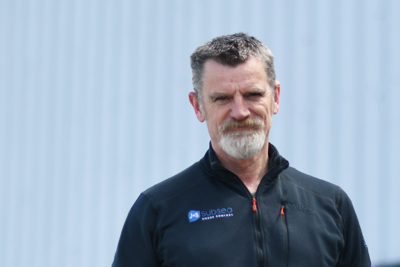
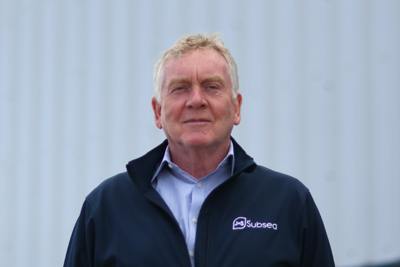
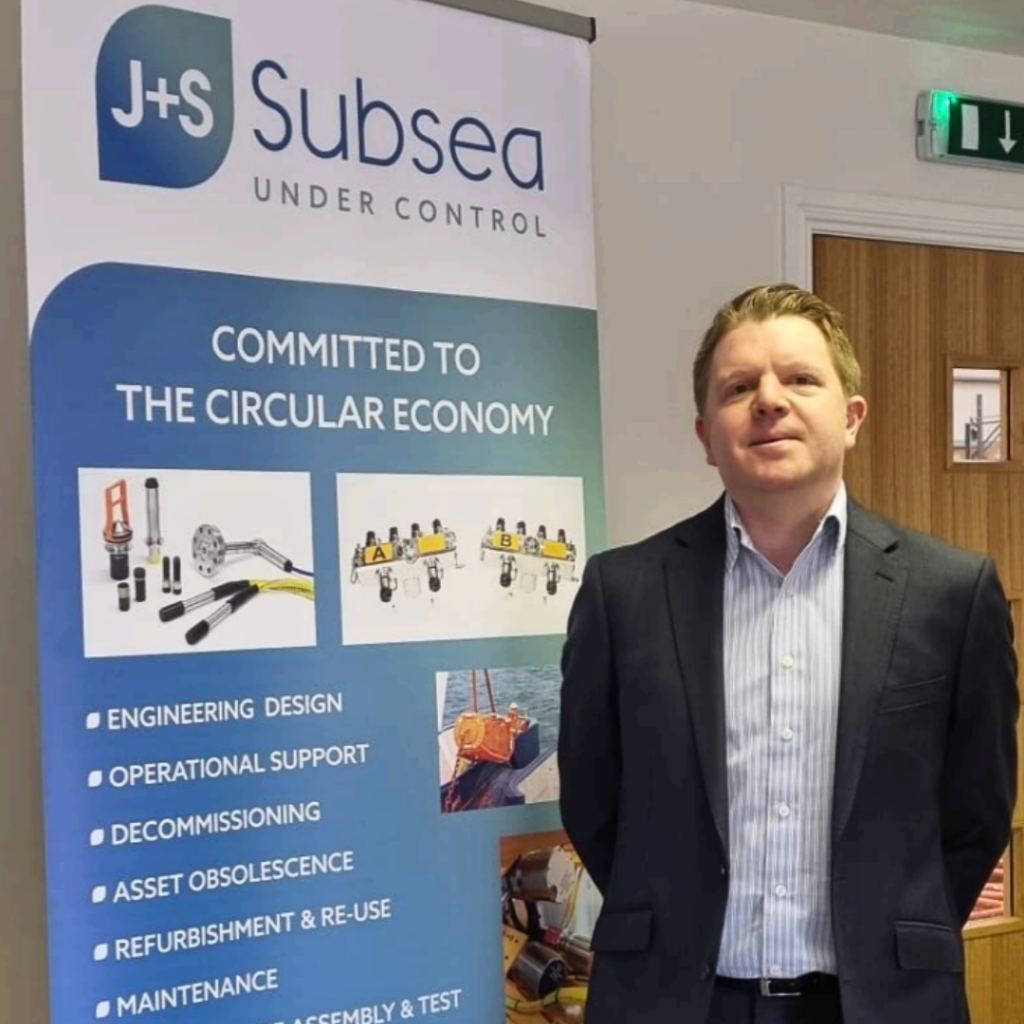
Managing Director Phil Reid said the plan reflects a practical approach grounded in how the business already operates.
“At J+S Subsea, innovation has never been about building new for the sake of it. Our Legacy Locker programme, which focuses on reuse, refurbishment and repurposing of subsea equipment, has long been central to how we deliver value for clients. This same thinking underpins our Net Zero Plan. It is about understanding our footprint, taking responsibility, and acting where we can make a meaningful impact.”
From sustainability reporting to measurable action
The Net Zero Plan outlines a series of time-bound and measurable targets aligned with Science Based Targets initiative guidance. Key commitments include reducing Scope 1 and Scope 2 emissions by 50 percent through planned solar PV installation and the phased removal of kerosene heating, expanding the Legacy Locker programme to reduce associated Scope 3 emissions by 30 percent, and cutting employee commuting emissions by 40 percent through a sustainable travel plan and flexible working practices.
J+S Subsea has already taken action by switching to 100 percent renewable electricity at its Dyce facility. Future initiatives include supplier engagement on carbon reduction targets, increased use of recycled and post-consumer materials, elimination of single-use plastics, and ongoing sustainability training for the workforce.
These actions reinforce the company’s commitment to circular economy principles, extending asset life, reducing waste and lowering carbon intensity while continuing to deliver reliable subsea engineering solutions.
Governance, transparency and accountability

Delivery of the Net Zero Plan will be overseen by an internal ESG Committee, chaired by the Financial Director, with progress reviewed against defined KPIs on a six-monthly basis. Performance and progress will be disclosed annually through J+S Subsea’s Sustainability Report, ensuring transparency for clients, partners and stakeholders.
Targets due to be achieved by 2030 will be submitted for validation through the Science Based Targets initiative by the end of 2027, with independent verification planned to support long-term credibility.
By publishing its Net Zero Plan, J+S Subsea reinforces its commitment to practical, engineering-led decarbonisation, combining circular economy principles, operational improvements and measurable action to support the energy industry’s transition.
To read J+S Subsea’s Net Zero Plan in full, including baseline emissions, reduction targets and the delivery roadmap, download the report here.